Introduction
The purpose of this page is to explain the emission allocation method in accordance with the internationally recommended guidelines described in the GLEC Framework v3.2 (October 2025, PDF), which is itself aligned with the ISO 14083:2023 standard. The goal of this method is to fairly distribute the emissions emitted during a trip between its various stops.
It covers the case that the GLEC Framework refers to as collection and delivery rounds (GLEC Framework v3.2, p. 48): shared transport operations with multiple pickup and delivery stops and varying load factors, which are particularly common in urban distribution. Emissions are distributed using a notional transport activity (in t·km), computed from the distance and the quantity at each stop (GLEC Framework v3.2, p. 21).
Requirements
To apply this method, it is required to know:
- The total emissions emitted during the trip, obtained from the PTV Developer Routing API over the whole round trip (the
ISO14083_2023calculation method is used throughout this page) - The loading and unloading at each stop of the trip
- The distance between the depot and each stop (see the Distance logic section)
- The entire trip, from the vehicle's departure to its return to the depot. The last waypoint must always be the depot or the final end of the trip.
Distance logic
For road transport, the GLEC Framework recognizes three approaches to establish this distance (GLEC Framework v3.2, p. 22 and p. 48). They are presented below in the order of preference recommended for road operations.
Shortest Feasible Distance (SFD) – recommended
The SFD is the shortest practical route between two locations, taking into account real operating conditions such as the physical restrictions of the vehicle (e.g. weight and height), road type, topography and congestion. It is the approach recommended by the GLEC Framework (GLEC Framework v3.2, p. 22 and p. 48).
The PTV Developer Routing API computes exactly this shortest feasible route with options[routingMode] set to SHORTEST. It is the recommended way to obtain the depot-to-stop distances for this allocation method.
Great Circle Distance (GCD) – alternative
The GCD (also called orthodromic or spherical distance) is the shortest distance between two points on the surface of the Earth, including the curvature of the Earth (GLEC Framework v3.2, p. 22). It does not require a routing engine and can be computed from the coordinates alone, which makes it a convenient fallback when a route-planning tool is not available.
For a depot A (longitudeA, latitudeA) and a delivery point B (longitudeB, latitudeB), with R the terrestrial radius (~6371 km), the distance is:
where the latitudes and longitudes are expressed in radians. This is the spherical law of cosines; the mathematically equivalent Haversine formula is often preferred for better numerical stability at short distances.
Actual distance corrected by a Distance Adjustment Factor (DAF) – alternative
When neither the SFD nor the GCD is available, the actual distance travelled can be used – for example from odometer readings or a known route (GLEC Framework v3.2, p. 22). Being the real driven distance, it includes diversionary and out-of-route driving, so it is typically longer than the SFD. To keep it comparable with an SFD-based activity, a Distance Adjustment Factor (DAF) is applied. For road transport, the GLEC default road intensity values are built on a +5 % actual-to-SFD distance conversion (GLEC Framework v3.2, p. 99 and p. 100).
How the DAF enters the emission calculation is covered in the Emission Intensity section.
Allocating emissions
To fairly divide the emissions generated during a depot-based pickup and delivery roundtrip, the allocation method computes a notional transport activity for each order from two inputs. The GLEC Framework introduces this notional transport activity to determine each consignment's share of the overall transport activity of a collection and delivery round, based on loading and unloading points and independent of the actual day-to-day routing (GLEC Framework v3.2, p. 48). It is computed from two inputs:
- The distance (km) between the depot and each order. The recommended choice is the Shortest Feasible Distance (SFD); the Great Circle Distance (GCD) or an adjusted actual distance (DAF) may also be used. See the Distance logic section for how to choose and compute each.
- The quantity: the sum of what has been loaded and unloaded during the stop, expressed as mass in tonnes (GLEC Framework v3.2, p. 21).
Emission values are then assigned to every order as follows:
- A notional transport activity (in t·km) is computed as the product of the distance and the quantity.
- The notional transport activities of all orders of the trip are added up.
- For each order, its share (%) of that sum is determined.
- The trip's total emissions are distributed to the orders according to these shares.
Trip emission intensity
An emission intensity expresses greenhouse gas emissions per unit of freight transported, in kg CO2e per tonne-kilometer (t·km). In the GLEC Framework, the emission intensity of a transport operation category (TOC) is a measure of physical efficiency, computed from the emissions and the real transport activity of the operation (GLEC Framework v3.2, p. 20–26).
The GLEC Framework defines it as the total GHG emissions of a specific transport activity divided by the quantity of that transport activity, in tonne-kilometers (GLEC Framework v3.2, p. 58):
The ratio computed in this allocation method has the same form, but its denominator is not the real transport activity: it is the notional transport activity used to split emissions between orders (GLEC Framework v3.2, p. 48). It is the total Well-to-Wheel trip emissions divided by the sum, over every delivery , of the depot-to-stop Shortest Feasible Distance multiplied by the quantity loaded and unloaded at that stop:
Both ratios divide emissions by a transport activity in t·km; the difference is how that activity is obtained. For a TOC it is the real transport activity of the operation; here it is a notional activity built from the depot-to-stop SFD and the quantity loaded and unloaded at each stop, serving only as an allocation key. Here is the number of deliveries in the trip.
The SFD is the recommended distance, but the same formula applies with the Great Circle Distance (GCD): only the distance term in the denominator changes. The two worked examples below compute the same trip first with the SFD, then with the GCD.
Because its denominator is a notional activity rather than the real transport activity, this trip emission intensity should not be compared directly with a TOC emission intensity or with the GLEC default intensity factors, which are built on the distance actually travelled (GLEC Framework v3.2, p. 58). It is a consistent ratio for this trip and this allocation, not a measure of the vehicle's physical efficiency.
Why the shortest feasible distance, not the driven distance
The emissions in the numerator come from the whole route the vehicle actually drove. The depot-to-stop distances in the denominator play a different role: they are not part of that route, but a notional measure of how far each stop is from the depot, used only to split the total emissions fairly between orders. The GLEC Framework computes this notional transport activity from the loading and unloading points, independent of the actual day-to-day routing (GLEC Framework v3.2, p. 48).
Using the shortest feasible distance keeps each order's share stable and reproducible, regardless of the visiting order or the traffic on a given day.
When a Distance Adjustment Factor applies
A Distance Adjustment Factor (DAF) matters only when emissions are estimated from an emission intensity factor, not when they are measured. If a default or carrier-provided road intensity is applied to an SFD-based activity, that intensity was built on the distance actually driven, so the two bases must be reconciled with a DAF – for road, the GLEC default intensities already embed a +5 % actual-to-SFD conversion (GLEC Framework v3.2, p. 99 and p. 100).
In this allocation method, no DAF is applied: the trip emissions are not estimated from an intensity factor but measured directly by the PTV Developer Routing API from the actual fuel consumption of the route (the ISO14083_2023 calculation method). The numerator is therefore already the real emission of the real route, so there is no distance basis to reconcile.
Example: 6-stops trip with Shortest Feasible Distance
In this example, a EUR_TRAILER_TRUCK running on DIESEL serves 6 pickup and/or delivery points before returning to the depot.
- The vehicle departs from and returns to the same depot.
- The shortest feasible distance between the depot and each stop is obtained from the PTV Developer Routing API (one request per stop, with
options[routingMode]set toSHORTEST). - The quantity of goods (here a weight in tonnes) loaded and unloaded at each stop is recorded.
- The total trip emissions are computed by the Routing API over the whole round trip with the
ISO14083_2023calculation method: 107.17 kg CO2e TTW and 126.26 kg CO2e WTW for a trip distance of 116.05 km.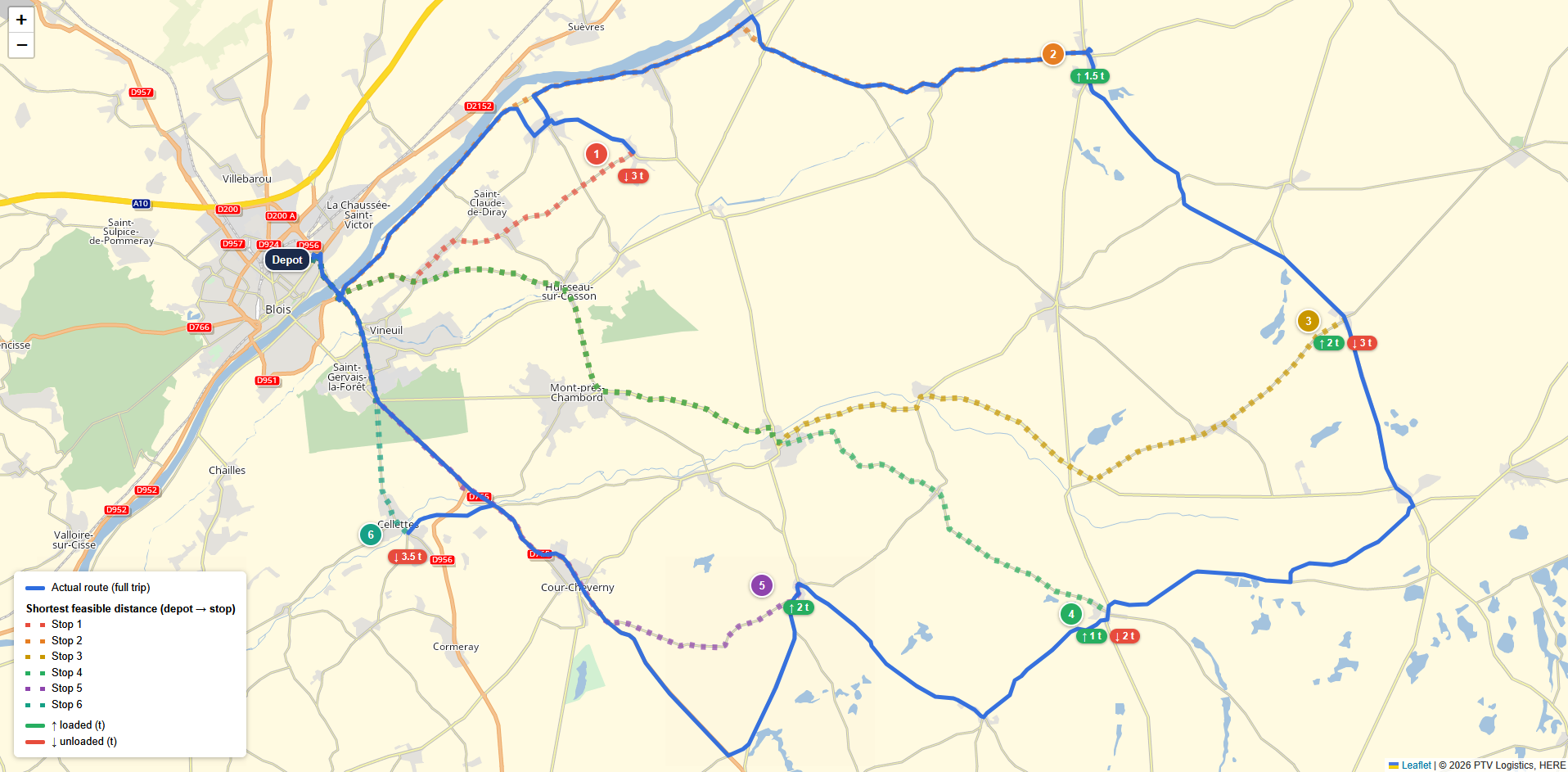
Each depot-to-stop SFD is obtained with a one-way request in SHORTEST routing mode. For example, for Order 1:
GET https://api.myptv.com/routing/v1/routes?waypoints=47.60172330919343,1.3461376412316497&waypoints=47.631694392163126,1.4808419292405972&profile=EUR_TRAILER_TRUCK&options[routingMode]=SHORTEST&apiKey=YOUR_API_KEYThe SFD is returned in the distance field (in meters). The same request is repeated for each of the 6 stops, changing only the second waypoints pair.
The total trip emissions come from a single request over the whole round trip (depot → 1 → 2 → 3 → 4 → 5 → 6 → depot) with the ISO14083_2023 method:
GET https://api.myptv.com/routing/v1/routes?waypoints=47.60172330919343,1.3461376412316497&waypoints=47.631694392163126,1.4808419292405972&waypoints=47.659945955125295,1.672317697136549&waypoints=47.5843764429456,1.7792946551219586&waypoints=47.50137296221314,1.6798710361256894&waypoints=47.50962954897736,1.5501540106546656&waypoints=47.523875820829375,1.3861568232383945&waypoints=47.60172340235499,1.3461406648718537&profile=EUR_TRAILER_TRUCK&emissionOptions[calculationMethods]=ISO14083_2023&apiKey=YOUR_API_KEYFor each stop, compute the notional transport activity as the product of the SFD and the quantity:
| Order | Shortest feasible distance (km) | Loaded (t) | Unloaded (t) | Quantity (t) | Notional transport activity (t·km) |
|---|---|---|---|---|---|
| Order 1 | 13.26 | 0 | 3 | 3 | 39.78 |
| Order 2 | 30.40 | 1.5 | 0 | 1.5 | 45.60 |
| Order 3 | 40.75 | 2 | 3 | 5 | 203.75 |
| Order 4 | 32.71 | 1 | 2 | 3 | 98.13 |
| Order 5 | 23.33 | 2 | 0 | 2 | 46.66 |
| Order 6 | 9.99 | 0 | 3.5 | 3.5 | 34.97 |
The quantity used in the computation is the sum of what is loaded and unloaded at the stop, so the notional transport activity is unaffected by how that quantity splits between loading and unloading.
The sum of all notional transport activities is 39.78 + 45.60 + 203.75 + 98.13 + 46.66 + 34.97 = 468.89 t·km.
Then, for each stop, compute its share (%) of that sum, and distribute the trip's total emissions accordingly:
| Order | Share (%) | CO2e Tank-to-Wheel (kg CO2e) | CO2e Well-to-Wheel (kg CO2e) |
|---|---|---|---|
| Order 1 | 8.48 | 9.09 | 10.71 |
| Order 2 | 9.73 | 10.42 | 12.28 |
| Order 3 | 43.45 | 46.57 | 54.87 |
| Order 4 | 20.93 | 22.43 | 26.43 |
| Order 5 | 9.95 | 10.67 | 12.57 |
| Order 6 | 7.46 | 7.99 | 9.42 |
| Total | 100 | 107.17 | 126.26 |
Finally, the emission intensity of the trip:
Example: same trip with the Great Circle Distance
For comparison, here is the same 6-stops trip computed with the Great Circle Distance (GCD) instead of the SFD. The waypoints, the quantities and the trip's total emissions are unchanged (107.17 kg CO2e TTW and 126.26 kg CO2e WTW): only the depot-to-stop distances differ, as the GCD is measured in a straight line rather than along the road network.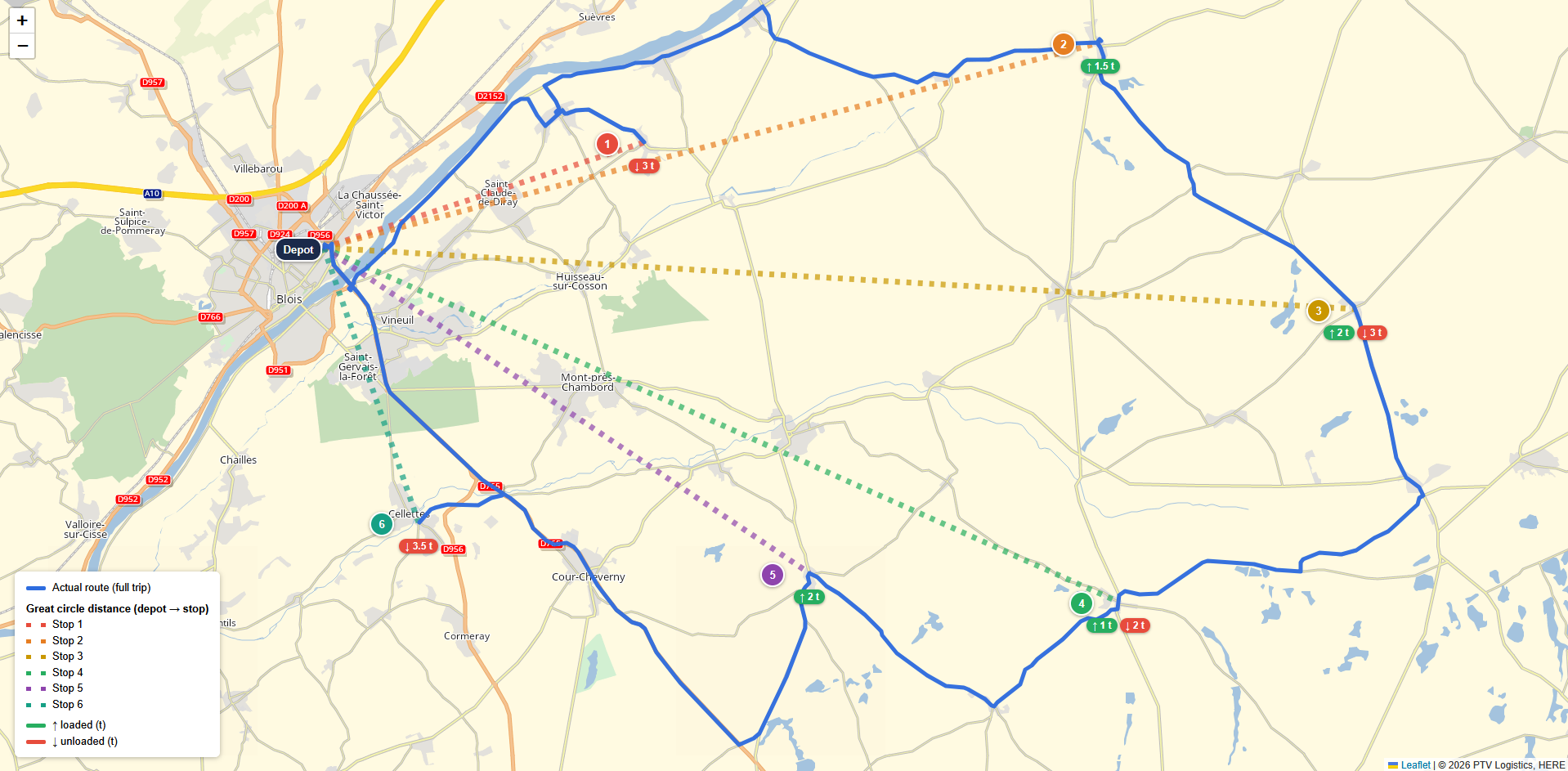
Each depot-to-stop GCD is computed from the coordinates with the spherical law of cosines (see the Distance logic section), so no routing request is required. For each stop, the notional transport activity is the product of the GCD and the quantity:
| Order | Great circle distance (km) | Loaded (t) | Unloaded (t) | Quantity (t) | Notional transport activity (t·km) |
|---|---|---|---|---|---|
| Order 1 | 10.63 | 0 | 3 | 3 | 31.90 |
| Order 2 | 25.29 | 1.5 | 0 | 1.5 | 37.93 |
| Order 3 | 32.54 | 2 | 3 | 5 | 162.70 |
| Order 4 | 27.42 | 1 | 2 | 3 | 82.26 |
| Order 5 | 18.42 | 2 | 0 | 2 | 36.84 |
| Order 6 | 9.16 | 0 | 3.5 | 3.5 | 32.07 |
The sum of all notional transport activities is 31.90 + 37.93 + 162.70 + 82.26 + 36.84 + 32.07 = 383.68 t·km (lower than the 468.89 t·km obtained with the SFD, since straight-line distances are shorter than the road distances).
Then, for each stop, compute its share (%) of that sum, and distribute the trip's total emissions accordingly:
| Order | Share (%) | CO2e Tank-to-Wheel (kg CO2e) | CO2e Well-to-Wheel (kg CO2e) |
|---|---|---|---|
| Order 1 | 8.31 | 8.91 | 10.50 |
| Order 2 | 9.89 | 10.59 | 12.48 |
| Order 3 | 42.40 | 45.44 | 53.54 |
| Order 4 | 21.44 | 22.98 | 27.07 |
| Order 5 | 9.60 | 10.29 | 12.12 |
| Order 6 | 8.36 | 8.96 | 10.55 |
| Total | 100 | 107.17 | 126.26 |
Finally, the emission intensity of the trip based on the GCD:
The total emissions distributed to the orders are identical to the SFD example; only the shares shift slightly, and the trip emission intensity is higher (0.329 vs 0.269 kg CO2e/t·km WTW) because the GCD denominator is smaller. For this reason, the GLEC Framework requires the type of distance used to be specified whenever a transport activity or an emission intensity is reported (GLEC Framework v3.2, p. 60 and p. 61).